


It’s Sunday evening, and that familiar knot in your stomach is already forming. Your mind races through tomorrow’s tasks, replaying difficult conversations with your manager, and dreading the mountain of emails waiting in your inbox. You haven’t even stepped into the office yet, but your heart is already pounding.
If this sounds familiar, you’re not alone. When your job causes you anxiety, it affects every aspect of your life—your sleep, your relationships, your health, and your sense of self-worth. But here’s what many people don’t realize: persistent work anxiety isn’t just stress, and you don’t have to live with it.
In this guide, we’ll explore how to recognize when normal job stress has crossed into anxiety territory, identify what might be triggering it, and most importantly, discover practical strategies you can use starting today to reclaim your peace of mind.
Understanding the Difference: Job Stress vs. Job Anxiety
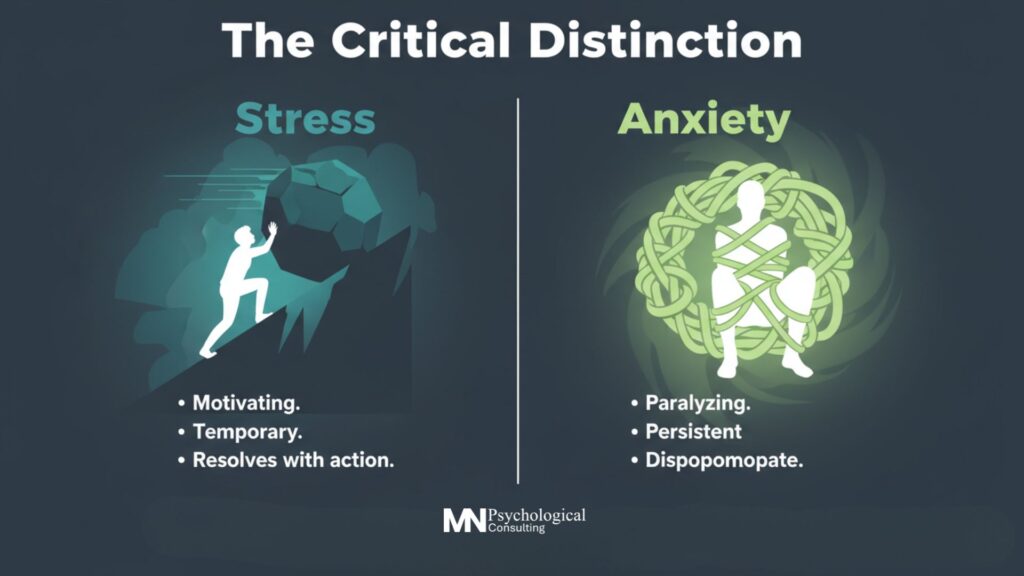
Not all workplace pressure is created equal. Stress is a natural response to demanding situations. Think of a big presentation, a tight deadline, or learning new responsibilities. It typically comes and goes with the situation itself.
Anxiety, however, is different. When your job causes you anxiety, the worry becomes persistent. It’s disproportionate to the actual circumstances. It doesn’t turn off when you leave the office or complete a task. Instead, it follows you home, disrupts your sleep, and colors how you view yourself.
Recognizing Physical Warning Signs
Physical symptoms that signal anxiety rather than normal stress include:
Your body keeps score even when your mind tries to push through. Chronic work anxiety often manifests as persistent headaches that won’t respond to medication. You might experience digestive issues that seem to worsen on workdays. Muscle tension particularly in your neck and shoulders becomes constant. Frequent illnesses occur as your immune system becomes compromised.
You might notice your heart racing even during routine tasks. Some people experience chest tightness that makes them wonder if something is seriously wrong. Others have panic attacks at work—sudden episodes of intense fear. These come with a rapid heart rate, sweating, trembling, and feeling like you can’t breathe.
Sleep disturbances become your new normal. Either you can’t fall asleep because your mind won’t stop replaying work scenarios, or you wake at 3 AM with your thoughts immediately jumping to work problems.
Emotional and Mental Red Flags
Emotional and mental warning signs include:
When your job causes you anxiety, you might feel a sense of dread. This starts building the night before work, or even on your days off. Decision-making becomes paralyzing, even for small choices you once made easily.
You find yourself constantly irritable with loved ones. You snap over minor issues because your stress capacity is already maxed out. A persistent feeling that you’re failing becomes your inner narrative, even when objective evidence suggests otherwise.
These negative thoughts might take over: “I’m not good enough,” “Everyone thinks I’m incompetent,” or “I’m going to get fired.” You might notice yourself catastrophizing. Every small mistake feels like it will lead to being fired or publicly humiliated. These anxiety symptoms can intensify over time if left unaddressed.
Behavioral Changes That Signal a Problem
Behavioral changes that indicate a problem:
Anxiety changes how we act. You might start avoiding certain people, meetings, or tasks that trigger your anxiety. Procrastination increases as avoidance becomes a coping mechanism.
Your work performance may decline, which then creates more anxiety in a vicious cycle. Some people cope by overworking. They stay late every night in an attempt to feel more in control or prove their worth. Others withdraw socially, declining invitations and isolating themselves from friends and family.
The Critical Distinction
The key distinction is this: stress motivates you to take action. It typically resolves when you address the stressor. Anxiety paralyzes you. It persists even after tasks are complete. It often feels overwhelming and inescapable.
Common Triggers: What Makes Your Job Cause You Anxiety
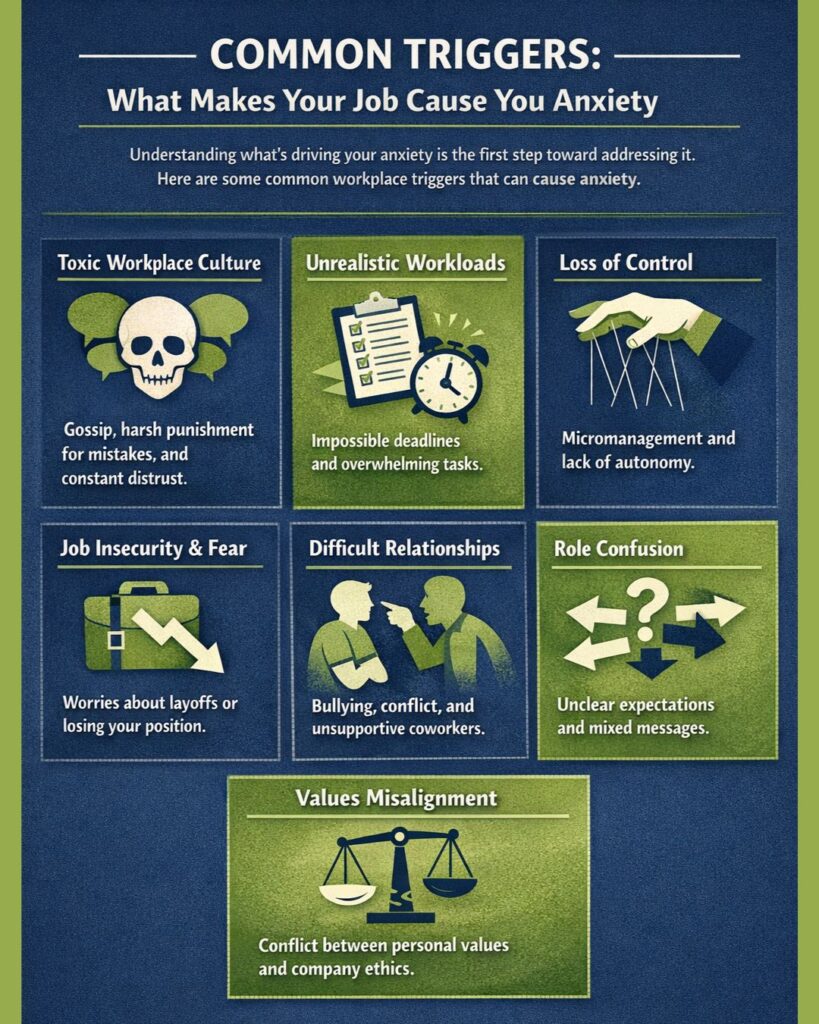
Understanding what’s driving your anxiety is the first step toward addressing it. Work anxiety rarely appears out of nowhere. It’s usually a response to specific workplace factors or a combination of triggers.
Toxic Workplace Culture
Toxic workplace culture can be a primary culprit. This might look like a culture where mistakes are punished harshly. These environments treat errors as failures rather than learning opportunities. Gossip and office politics might dominate daily interactions. Employees are pitted against each other rather than encouraged to collaborate.
When trust is absent and you constantly feel like you need to watch your back, anxiety becomes your brain’s protective response. Your nervous system treats it as a genuinely threatening environment.
Unrealistic Workloads and Deadlines
Unrealistic workloads and expectations create a different kind of pressure. When your job causes you anxiety because you’re consistently given more work than can reasonably be accomplished, your body and mind never get a chance to recover.
You’re always behind, always playing catch-up. The finish line keeps moving further away. This is compounded when deadlines are arbitrary or constantly shifting. You feel like you can never quite get your footing.
Loss of Control and Autonomy
Lack of control or autonomy over your work can be surprisingly anxiety-inducing. When every decision must be approved, you lose a sense of agency. Being micromanaged to the point of suffocation makes the situation unbearable. Without any input into how you accomplish your tasks, you are left feeling powerless.
Humans need some degree of control over their environment to feel psychologically safe. Without it, anxiety fills the void.
Job Insecurity and Fear
Job insecurity creates a unique form of chronic anxiety. Whether it’s due to company restructuring, industry instability, or performance concerns, the fear of losing your income creates constant stress. The threat of losing your professional identity keeps your nervous system in a state of constant alert.
This is especially challenging because the threat feels both significant and outside your control.
Difficult Workplace Relationships
Difficult workplace relationships can make even a dream job unbearable. A hypercritical manager who never acknowledges your contributions drains your confidence. Colleagues who undermine or bully you create daily stress. A boss with unpredictable mood swings means you’re constantly walking on eggshells.
When your job causes you anxiety because of interpersonal dynamics, it’s particularly draining. Humans are wired for connection, and workplace relationships represent a significant portion of our social interactions.
For some people, this can develop into social anxiety at work. This is an intense fear of being judged, embarrassed, or humiliated in social situations with colleagues. It might manifest as avoiding team meetings, dreading presentations, or feeling paralyzed during networking events.
Role Confusion and Conflicting Expectations
Role ambiguity or conflicting expectations leave you constantly second-guessing yourself. Unclear expectations about what success looks like in your position will naturally lead to anxiety. The problem intensifies when different stakeholders give you contradictory direction, leaving you unsure which way to turn. Ultimately, confusion reigns if your job description bears little resemblance to what you actually do.
You’re trying to hit a target you can’t see. This is both exhausting and demoralizing.
Values Misalignment
Values misalignment can create deep-seated anxiety that’s hard to pinpoint. When your personal values conflict with company practices, you experience cognitive dissonance. This might involve how employees are treated, business ethics, or the impact of the work itself. This internal conflict manifests as persistent unease and anxiety.
Immediate Strategies: Finding Relief Right Now
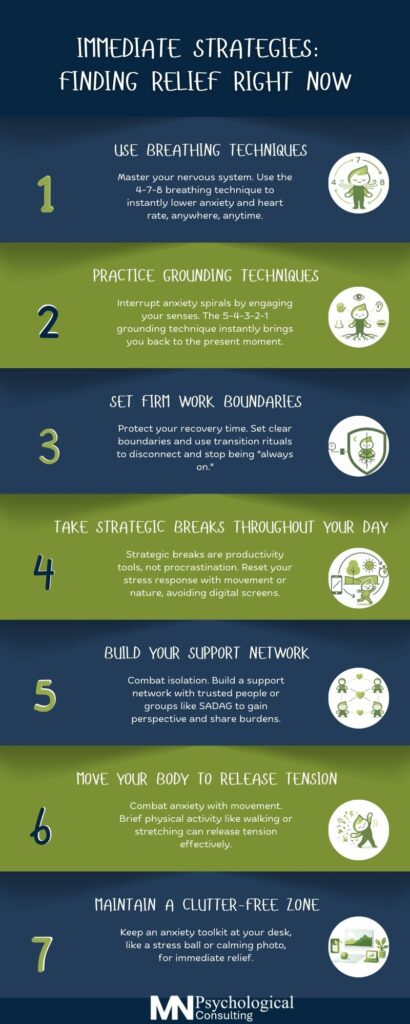
When your job causes you anxiety and you’re in the thick of it, you need tools that work quickly. These immediate strategies can help you manage acute anxiety symptoms. They create some breathing room while you work on longer-term solutions.
Use Breathing Techniques to Calm Your Nervous System
Master your breath, master your nervous system. When anxiety strikes during your workday, your breathing often becomes shallow and rapid. This signals danger to your brain and intensifies anxiety.
Try the 4-7-8 breathing technique: breathe in through your nose for four counts, hold for seven counts, and exhale slowly through your mouth for eight counts. Repeat this four times. This activates your parasympathetic nervous system, which is responsible for the “rest and digest” response.
These breathing exercises can lower your heart rate. They reduce physical symptoms of anxiety within minutes. You can do this at your desk, in a bathroom stall, or in your car before walking into the office. The beauty of breathwork is that it’s always available and works within minutes.
Practice Grounding Techniques
Grounding techniques bring you back to the present. Anxiety pulls your mind into the future, imagining worst-case scenarios. The 5-4-3-2-1 technique interrupts this spiral by engaging your senses.
Identify five things you can see, four things you can touch, three things you can hear, two things you can smell, and one thing you can taste. This simple exercise redirects your attention. It brings you from anxious thoughts to your immediate physical environment, where the feared catastrophe isn’t actually happening.
Set Firm Work Boundaries
Set firm boundaries to protect your recovery time. When your job causes you anxiety, the temptation is to be “always on.” You want to prove your worth or stay ahead of the workload. This backfires.
Establish specific work hours and communicate them clearly. Turn off work email notifications after a certain time. Create a physical or mental transition ritual when you finish work. Change clothes, take a short walk, or listen to a specific playlist. Your brain needs clear signals that work has ended and it’s time to shift gears.
Take Strategic Breaks Throughout Your Day
Strategic breaks are not procrastination, they’re productivity tools. Research shows that our brains can only focus intensely for about 90 minutes before needing a break. When anxiety is high, this window may be even shorter.
Set a timer for 25 or 50 minutes of focused work, then take a genuine break. Walk around, stretch, look out a window at something distant. Don’t scroll social media or check email; these don’t allow your mind to truly rest. Even five minutes of movement or looking at nature can reset your stress response.
Build Your Support Network
Build your support network intentionally. Isolation intensifies anxiety. Identify at least two or three people you can talk to about work stress. Ideally, choose a mix of colleagues who understand your specific situation and friends or family outside your workplace who can offer perspective.
Consider joining support groups for workplace stress or mental health, either in-person or online. Organizations like the South African Depression and Anxiety Group (SADAG) facilitate support groups. These can connect you with others facing similar challenges.
Don’t just vent; ask for specific support. “Can I talk through this situation with you?” or “I need to vent for five minutes, then I need help problem-solving” gives people a clear way to help you.
Move Your Body to Release Tension
Move your body to move the anxiety. Physical activity is one of the most effective immediate interventions for anxiety. You don’t need a gym membership or an hour-long workout.
A 10-minute walk, doing stretches at your desk, or even tensing and releasing muscle groups can help. These activities discharge the physical tension that accompanies anxiety. If possible, exercise before work to set a calmer tone for your day, or at lunch to break up the stress accumulation.
Create an Anxiety Toolkit
Create an anxiety toolkit. Keep items at your desk that help regulate your nervous system. Consider a stress ball or fidget tool, essential oils like lavender or peppermint, a photo that makes you smile, noise-canceling headphones, or hard candy to engage your senses.
When anxiety spikes, having immediate tools you can reach for provides a sense of control. These simple items can interrupt the anxiety spiral before it gains momentum.
Long-Term Solutions: Addressing the Root Causes
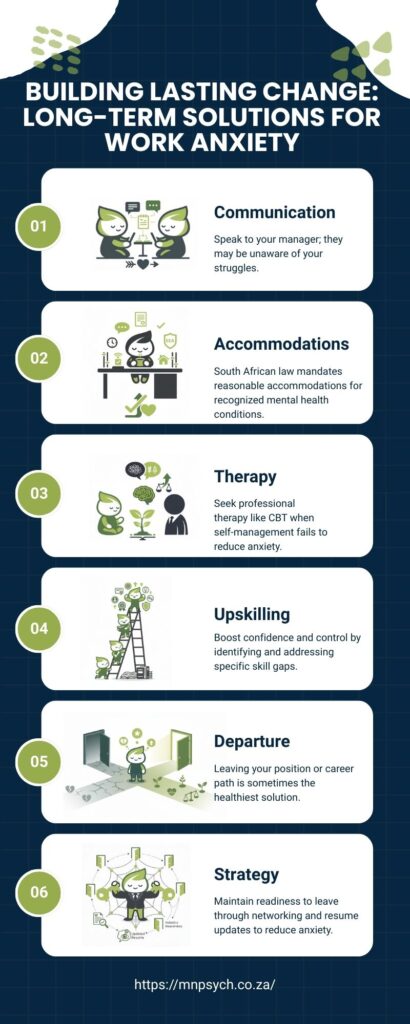
Immediate coping strategies are essential. But when your job causes you anxiety consistently, you need to address the underlying issues. Long-term solutions require more courage and effort, but they’re what ultimately transform your experience of work.
Have Courageous Conversations With Leadership
Have courageous conversations with your manager. This might feel terrifying, especially when anxiety has convinced you that you’re the problem. But many managers are unaware of how their expectations or management style affect their team.
Prepare for this conversation by documenting specific situations, their impact on you, and potential solutions. Frame it as “I want to do my best work, and I need support with X” rather than as complaints.
Request specific accommodations: adjusted deadlines, clearer priorities, more frequent check-ins, or different communication methods. If your manager is receptive, create an action plan together and schedule follow-up conversations. If they’re not receptive, you’ve gained valuable information about whether this environment can change.
Explore Workplace Accommodations
Explore formal workplace accommodations. In South Africa, the Employment Equity Act recognizes mental health conditions as potential disabilities. These may require reasonable workplace accommodations.
This might include flexible work hours, the option to work remotely when needed, modified break schedules, or adjustments to your work environment such as a quieter workspace. Consult with your HR department or occupational health practitioner about what options might be available to you.
Documentation from a mental health professional or psychologist strengthens accommodation requests. Many South African companies are increasingly recognizing the importance of mental health support. They’re incorporating this into their employee wellness programmes.
Seek Professional Mental Health Support
Invest in professional mental health support. When your job causes you anxiety that persists despite your best efforts at self-management, therapy can be transformative. Cognitive Behavioral Therapy has strong evidence for treating anxiety disorders.
It can help you identify thought patterns that intensify anxiety. You’ll develop more balanced perspectives and build specific skills for managing workplace stress. Many South African employers offer Employee Assistance Programs (EAPs) or employee wellness programmes. These provide free counseling sessions—check with your HR department about what’s available.
Organizations like SADAG (South African Depression and Anxiety Group) can also help you find affordable mental health resources. A registered psychologist or counsellor who specializes in workplace issues or anxiety disorders can help. They’ll determine whether your anxiety is primarily about your coping skills, your work environment, or both.
Develop Skills That Increase Confidence
Develop skills that increase confidence and control. Sometimes anxiety stems from feeling genuinely unprepared or unskilled. Identify specific skill gaps that contribute to your anxiety and create a development plan.
This might mean taking courses in time management, communication, technical skills relevant to your role, or leadership. Many anxiety-inducing situations improve dramatically when you build genuine competence.
Additionally, developing skills increases your career options. This reduces the anxiety that comes from feeling trapped.
Know When It’s Time to Leave
Know when it’s time to consider leaving. This is often the hardest truth to face. Sometimes when your job causes you anxiety, the healthiest long-term solution is to find a different position. You might even need to explore a different career path.
You should consider leaving if your physical or mental health is seriously deteriorating despite your best efforts. Think about it when the toxic elements are baked into the company culture rather than being fixable issues. A fundamental misalignment between your values and the work itself is another strong reason. Finally, if you’ve tried to address the issues and nothing has changed, it may be time to go.
Importantly, make this decision from a place of self-care rather than panic. Having a plan—updating your resume, building your network, and researching other opportunities—can actually reduce anxiety. You’re taking action rather than feeling trapped.
Create an Exit Strategy
Create an exit strategy even if you’re not ready to leave. Knowing you have options is itself anxiety-reducing. Update your resume regularly. Keep a record of your accomplishments. Stay connected with your professional network. Maintain awareness of what opportunities exist in your field.
This isn’t about being disloyal; it’s about maintaining your sense of agency. When you know you could leave if needed, you often feel less desperate. You feel less anxious about your current situation.
Building Resilience: Protecting Yourself While You Work
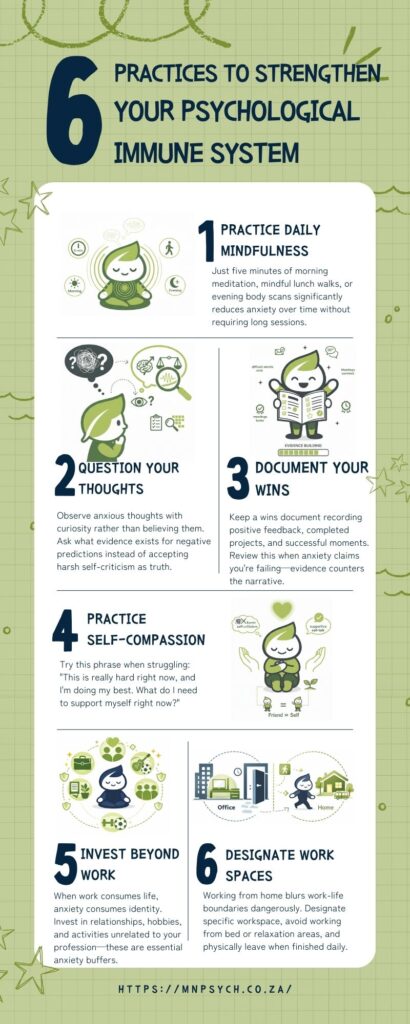
Even in less-than-ideal work environments, you can build practices that make you more resilient to anxiety. Think of these as strengthening your psychological immune system.
Develop a Mindfulness Practice
Cultivate a mindfulness practice tailored to your life. Mindfulness doesn’t require hour-long meditation sessions. Even five minutes of morning meditation, mindful walking during lunch, or a body scan before bed can significantly reduce baseline anxiety over time.
The practice of noticing thoughts without getting swept away by them is particularly powerful for work anxiety. This is helpful when catastrophic thinking often runs wild. Apps like Headspace, Calm, or Insight Timer offer guided practices specifically for workplace stress.
Reframe Your Anxious Thoughts
Reframe your relationship with anxious thoughts. When your job causes you anxiety, your mind likely generates a lot of negative predictions and harsh self-criticism. Rather than trying to eliminate these thoughts, practice observing them with curiosity.
Ask yourself: “There’s that thought again that I’m going to be fired. What evidence do I actually have for this?” Or consider: “My brain is trying to protect me by imagining worst-case scenarios, but that doesn’t make them true.”
This creates distance between you and your negative thoughts, reducing their power. Naming the anxiety can also help: “This is my Sunday night dread. It’s a pattern, not a prophecy.” Challenge catastrophic thinking by asking yourself: “What’s the worst that could actually happen? What’s most likely to happen? And if the worst did happen, how would I cope?”
Celebrate Your Small Wins
Celebrate small wins intentionally. Anxiety has a negativity bias. It remembers every mistake and dismisses every success. Counter this by actively acknowledging your accomplishments, no matter how small.
Sent a difficult email? Acknowledge it. Got through a tough meeting? Notice that. Keep a “wins” document where you record positive feedback, completed projects, and moments you handled something well. Review this when anxiety tells you you’re failing. Your brain needs evidence to counter the anxiety narrative.
Practice Self-Compassion
Practice self-compassion like your wellbeing depends on it. Because it does. When you make a mistake or face a setback, notice how you talk to yourself. Would you speak to a friend struggling with anxiety the way you speak to yourself?
Self-compassion isn’t self-indulgence; research shows it actually improves performance and resilience. When your job causes you anxiety, you’re already dealing with enough. Don’t add self-criticism to the burden.
Try this phrase: “This is really hard right now, and I’m doing the best I can. What do I need to support myself?”
Protect Your Identity Outside of Work
Protect your non-work identity. When work consumes your life, anxiety about work consumes your identity. Invest in relationships, hobbies, and activities that have nothing to do with your professional life.
These aren’t luxuries; they’re essential buffers against work anxiety. They remind you that you’re more than your job title. They provide sources of meaning and accomplishment independent of workplace validation.
Create Physical Distance When Possible
Create physical distance when possible. If you work from home and your job causes you anxiety, the psychological boundary between work and personal life can blur dangerously. Designate a specific workspace. Avoid working from your bed or relaxation spaces.
When work ends, physically leave that space. If you work in an office, create a commute ritual. Even walking around the block marks the transition between work and home.
Taking the First Step Forward
When your job causes you anxiety, it’s easy to feel powerless. But here’s what you need to know: you have more control than anxiety wants you to believe. The fact that you’re reading this article means you’ve already taken the first and most important step. You’re acknowledging that something needs to change.
You don’t have to implement everything in this guide tomorrow. In fact, trying to do too much at once might increase your anxiety. Instead, choose one strategy that resonates with you. Commit to trying it for a week.
Maybe it’s the breathing exercises during your morning commute. Perhaps it’s finally scheduling that conversation with your manager. Or it could be reaching out to a therapist or mental health professional.
Remember that anxiety about work is incredibly common in South Africa and worldwide. You’re not weak, you’re not failing, and you’re not alone. The difference between people who successfully manage work anxiety and those who continue to suffer isn’t about being stronger or tougher. It’s about recognizing the problem, seeking support, and taking small, consistent steps toward change.
Your job is an important part of your life, but it’s not your whole life. You deserve to work without constant dread, to sleep without your mind racing about tomorrow’s tasks, and to enjoy your time off without work anxiety casting a shadow over everything.
If you’re struggling right now, be gentle with yourself. Change takes time, and some situations require professional help to navigate. There’s no shame in reaching out to a therapist, counselor, or trusted mentor. In fact, seeking help is one of the most courageous and effective things you can do.
Take a deep breath. You’ve got this.
Need immediate support? If your anxiety is severe or you’re having thoughts of self-harm, please reach out to a mental health professional immediately. In South Africa, you can contact the South African Depression and Anxiety Group (SADAG) on 0800 567 567 or SMS 31393. Your mental health and wellbeing matter more than any job.
About MN Psychological Consulting: Based in Centurion, we specialize in organizational psychology, psychometric assessments, and workplace wellbeing solutions. If your organization needs support with employee wellness programmes, stress management training, or creating psychologically safe work environments, contact us to learn how we can help transform your workplace culture and support your team’s mental health.

